




What Is a Multipoint Locking Mechanism? Full Guide
If you own a uPVC or composite door, you’ve got a multipoint locking mechanism whether you’ve ever thought about it or not — it’s the reason lifting the handle before turning the key is essential, not optional. Understanding roughly how it works makes it much easier to describe a fault accurately, and to know whether it’s a quick fix or something more serious.
What “multipoint” actually means
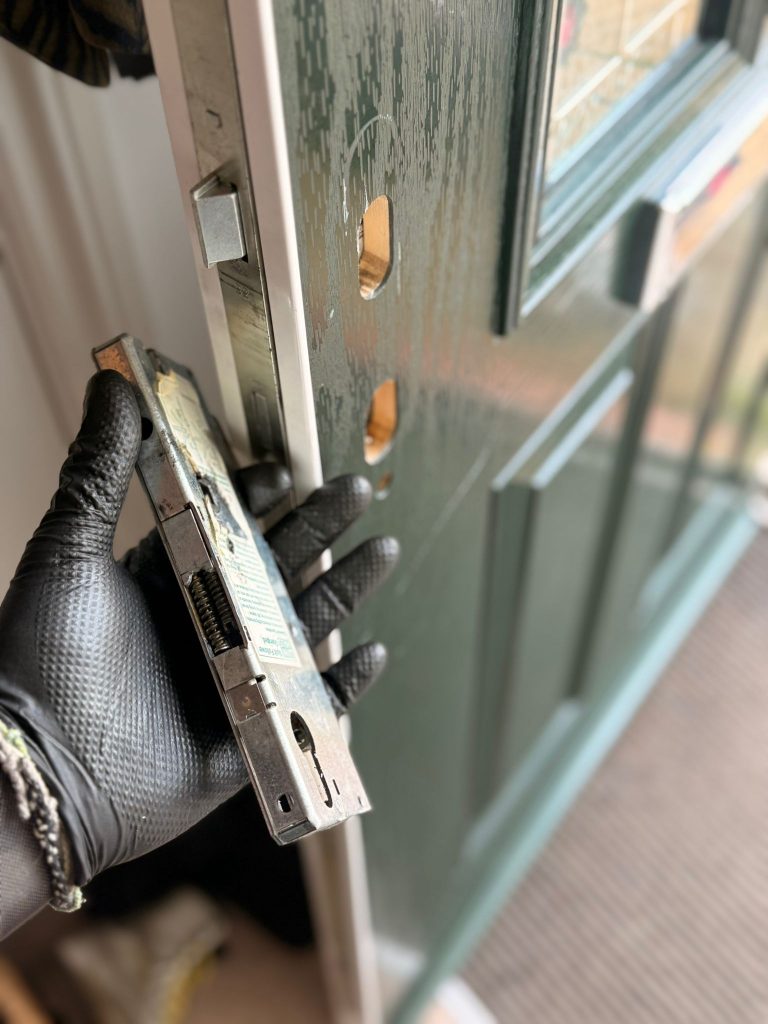
Older timber doors typically lock at a single point — one bolt, roughly at handle height, engaging one keep in the frame. A multipoint mechanism, by contrast, locks the door at several points along the edge simultaneously: usually a mix of hooks, rollers and a deadbolt, spaced from top to bottom of the door.
This is why uPVC and composite doors feel different to lock. Lifting the handle doesn’t just move one bolt — it drives every locking point out along the edge of the door and into its matching keep in the frame, all at once. Turning the key afterwards then usually engages an additional deadbolt for extra security, and in many cases activates an anti-lift or anti-thrust feature that stops the mechanism being forced back in from outside.
How the mechanism actually works
Inside the edge of the door sits a long metal strip called the lock case or faceplate assembly, running from top to bottom. Attached to it, spaced at intervals, are the individual locking points:
- Hooks — curved steel hooks, usually positioned mid-height and toward the top and bottom, that swing out and hook behind a keep in the frame. Hooks are difficult to force back once engaged, which is why they’re typically placed at the most vulnerable points.
- Rollers — cylindrical pins that push straight out into a keep, providing secure engagement without the hooking action.
- Deadbolt — a solid bolt, usually near the handle, that’s driven out by the key rather than the handle lift, adding a further layer of security.
When you lift the handle, a cam inside the mechanism rotates and drives all the hooks and rollers out simultaneously through a system of connecting rods running the length of the lock case. This is why a uPVC door needs the handle lifted firmly before the key will turn — the key alone typically only operates the deadbolt, not the full mechanism.
The euro cylinder (the part the key goes into) sits in the middle of this system and, once the handle has engaged the hooks and rollers, turning the key rotates the cylinder’s cam, which drives the separate deadbolt and can also lock the handle itself so it can’t be lifted from outside.
Common faults and what causes them
The handle lifts but won’t lock (key won’t turn)
Almost always a door alignment problem — the door has dropped slightly on its hinges, so the hooks and rollers no longer line up with their keeps in the frame. Usually fixed with a hinge adjustment rather than any part replacement.
The handle feels loose, floppy, or doesn’t spring back
This points to the handle spring inside the handle itself, which has weakened or failed — a very common wear item on doors used many times a day, and usually straightforward to replace.
The handle is very stiff, or one hook or roller isn’t engaging
A stiff handle can mean the mechanism is starting to wear, a keep is misaligned, or the door needs realigning — forcing it repeatedly tends to accelerate the damage. A single hook or roller not engaging is often just that one part worn or bent, or its keep shifted out of position, and is sometimes replaceable on its own rather than needing the whole mechanism changed.
The key turns but the door doesn’t feel secure, or it won’t lock at all even after realigning
This is more serious and usually points to the connecting rods inside the mechanism having failed or disconnected. At this point the mechanism itself has likely failed internally and needs replacing rather than repairing — worth getting looked at promptly, since a door that won’t lock securely is a genuine security gap.
Repair or replace?
This is the question that matters day to day, and the honest answer is it depends what’s failed, which is hard to diagnose with certainty without opening the mechanism up.
- Repair is usually possible when: the fault is alignment-related, a single hook or roller has failed, the handle spring has gone, or a keep needs adjusting.
- Replacement is usually better when: the mechanism is old with several faults appearing together, the connecting rods have failed, it’s a discontinued or unusual size hard to source parts for, or a repair would cost close to a full replacement anyway.
As a rule of thumb, a door that’s been sticking or misbehaving for a long time before the lock failed has likely been under strain for a while, so a full replacement is often the more durable fix even if a repair is technically possible short-term.
Measuring for a replacement
If a mechanism does need replacing, a few measurements make a real difference to getting the right part first time:
- Backset — the distance from the edge of the door to the centre of the euro cylinder hole.
- Case length — the length of the lock case itself, top to bottom.
- Centres — the distance between the euro cylinder hole and the handle spindle hole.
- Follower size — the spindle dimension the handle connects to.
Getting any of these wrong is the most common reason a replacement mechanism doesn’t fit — it’s worth having these confirmed by whoever’s doing the work rather than guessing from an old part.
When to call a locksmith
Diagnosing a multipoint mechanism fault accurately — and telling the difference between alignment, a handle spring, a single locking point, or a full mechanism failure — is exactly the kind of job worth having assessed properly rather than guessed at, since fitting the wrong part wastes both time and money. Our uPVC & door lock repair service covers diagnosing and fixing multipoint mechanism faults, and where a full replacement is genuinely needed, our lock replacement and upgrades service covers that too.
Max covers Nottingham, Derby, Mansfield, Loughborough and the surrounding towns and villages — £85 plus parts if any are needed, no call-out fee, and the same price wherever you are in the coverage area. Most jobs are sorted on the first visit, with the price agreed before any work starts. If your door won’t lock securely and you need it looked at urgently, our emergency locksmith team can help.
Frequently asked questions
What’s the difference between a multipoint mechanism and a normal lock?
A normal (single-point) lock secures a door at one point, usually with a single bolt. A multipoint mechanism locks the door at several points simultaneously — typically a mix of hooks, rollers and a deadbolt — spread along the edge of the door for much stronger security.
Why do I have to lift the handle before the key will turn?
Lifting the handle drives the hooks and rollers out into their keeps in the frame. The key then usually only operates a separate deadbolt. If the handle isn’t lifted fully, the hooks and rollers aren’t engaged and the key has nothing to turn against.
My handle feels loose and doesn’t spring back — is that the mechanism?
Usually it’s the handle spring inside the handle itself rather than the full locking mechanism, and it’s typically a straightforward and inexpensive fix.
Can a multipoint mechanism be repaired, or does it always need replacing?
Many faults can be repaired — alignment issues, a single failed hook or roller, or a worn handle spring are all commonly fixable. Full replacement is usually only needed when the mechanism has failed more broadly or parts aren’t available.
How much does it cost to fix a multipoint mechanism in Nottingham?
Max charges £85 plus parts if any are needed, with no call-out fee and the same price across the coverage area. Most jobs are completed on the first visit, with the price agreed before work starts.
Related: uPVC & Door Lock Repair · Lock Replacement & Upgrades · Emergency Locksmith
Sorted? What most readers check next
- Door lock & mechanism repair — handles, gearboxes, multipoint systems
- Locksmith prices in Nottingham — the transparent 2026 guide
- Do Locksmiths Need a Licence in the UK? The Facts
Need it sorted today? Call 07552 421433 — £85 + parts (+ VAT), no call-out fee, same price 7 days.