




Upgrading Doors & Windows in Nottingham: What’s Worth Doing First
The short answer: most Nottingham homes don’t need new doors — they need the right upgrades in the right order. A certified anti-snap cylinder (£110–£150 all in) beats a £2,000 door swap for security-per-pound, and handles, hinges and mechanism tune-ups follow close behind. Here’s the priority order that actually pays.
Door and window upgrades in Nottingham are rarely about fashion. Across the city and its suburbs, the pattern of residential burglary follows a fairly consistent logic: most forced entries happen through the front or back door, and in the majority of cases the weak point is either a snapping attack on the euro cylinder or a frame that gives way under pressure. The lock holds and the door fails, or the lock fails because it was a basic cylinder with no anti-snap protection and it was through in seconds. That is why any serious conversation about home security in Nottingham has to include the doors and windows themselves, not just the lock. A high-quality lock on a weak door is still a weak door, and a solid door with an outdated cylinder offers less protection than it appears to. This guide explains why local homeowners upgrade, and what a genuinely good upgrade actually involves.
The security case for modern doors
uPVC doors became the standard across UK housing from the 1980s onwards, and the vast majority of Nottingham homes have at least one. They are excellent in many respects, but the euro cylinders they were originally fitted with have historically been the weak point. Cylinder snapping requires no technical skill, takes seconds, and defeats a standard cylinder completely, at which point the rest of the door, however sound, becomes irrelevant.
Upgrading to an anti-snap, anti-drill, anti-pick cylinder is the minimum sensible step for any uPVC door, and it is inexpensive relative to the protection it buys. Beyond the cylinder, composite doors have become the preferred choice for homeowners who want a more substantial front door. They combine a solid core with a tough GRP or aluminium skin, making them far more resistant to physical attack than a hollow uPVC panel, and most come with a multipoint locking mechanism as standard, distributing the locking force up the full height of the door rather than relying on a single bolt. Our door lock repair and upgrade service handles exactly this kind of work.
Don’t overlook the frame
Reinforced frames are the part of the equation people most often forget. A door that locks at five points is only ever as strong as the frame it locks into, and older timber frames can fail at the keep even when the lock itself holds firm. If the frame around your front or back door is original to the property and the house is more than twenty years old, it is worth having it assessed alongside any door or lock upgrade, rather than spending on a strong door bolted into a tired frame.
Window security: the entry point that gets ignored
Windows account for a meaningful share of residential break-in entry points, yet they get far less attention than doors when people think about security. The most common weakness is not smashed glass, which draws attention, but a compromised locking mechanism or an older window with a single-point latch that offers little resistance.
Modern window installations include multipoint locks, laminated or toughened glazing and internal beading, which stops the glass being removed from outside. If your windows are more than fifteen years old and the locks have never been upgraded, a security check is a sensible precaution. Ground-floor windows and any window reachable from a low roof, a flat-roof extension or a garden wall are worth treating as potential targets, particularly given the steady level of opportunistic property crime across the NG postcodes covering the city, Sherwood, Mapperley, Carlton and the surrounding suburbs.
Energy performance: the practical argument
Security aside, the energy case for upgrading doors and windows in Nottingham is compelling. The East Midlands has a large stock of older housing, and plenty of local properties still have single-glazed windows or doors with poor sealing. Heat lost through an unsealed door frame or a failing window gasket adds up across a winter, and the improvement after fitting a modern, well-sealed unit is usually noticeable from the very first heating bill.
Double glazing is not simply about the glass. The frame material, the quality of the seals and the depth of the cavity all affect thermal performance, and a correctly fitted double-glazed unit will significantly outperform an older one even when the old unit looks fine on the surface. It is also worth remembering that a well-sealed door only stays well-sealed while its hinges are aligned and its weather seals are intact, which is where ongoing repair and adjustment come in.
What a good upgrade actually involves
A worthwhile door and window upgrade is more than swapping one panel for another. Done properly, it looks at the whole system:
- The cylinder. An anti-snap, anti-drill, anti-pick euro cylinder is the single most effective security upgrade for most homes.
- The locking mechanism. A modern multipoint mechanism that engages several points up the frame, in good working order and correctly aligned.
- The door itself. A solid composite or well-reinforced uPVC door that resists force rather than flexing under it.
- The frame and keeps. Reinforced keeps and a sound frame, so the locking points have something strong to bite into.
- The windows. Multipoint window locks, toughened or laminated glazing and internal beading, especially on accessible ground-floor windows.
- The seals. Intact weather seals throughout, to hold in heat and keep out draughts and damp.
Get those working together and you have a genuine improvement in both security and comfort. Miss one, a strong door on a weak frame, or new glass behind an old, snappable cylinder, and you have spent money without closing the gap.
When to involve a locksmith in a door or window project
Not every door or window upgrade needs a locksmith. But if the project involves fitting or replacing locks, upgrading cylinders, or assessing the security of the existing frame alongside new glass or a new door panel, that is precisely where Max comes in. Two situations come up again and again: homeowners who have had new doors fitted but want the factory-fitted cylinder swapped for a higher-specification anti-snap unit, and homeowners who have upgraded their windows but still have the original handles and locks from the previous installation. Both are quick, high-value jobs that finish off an upgrade properly.
Common door and window faults Max attends
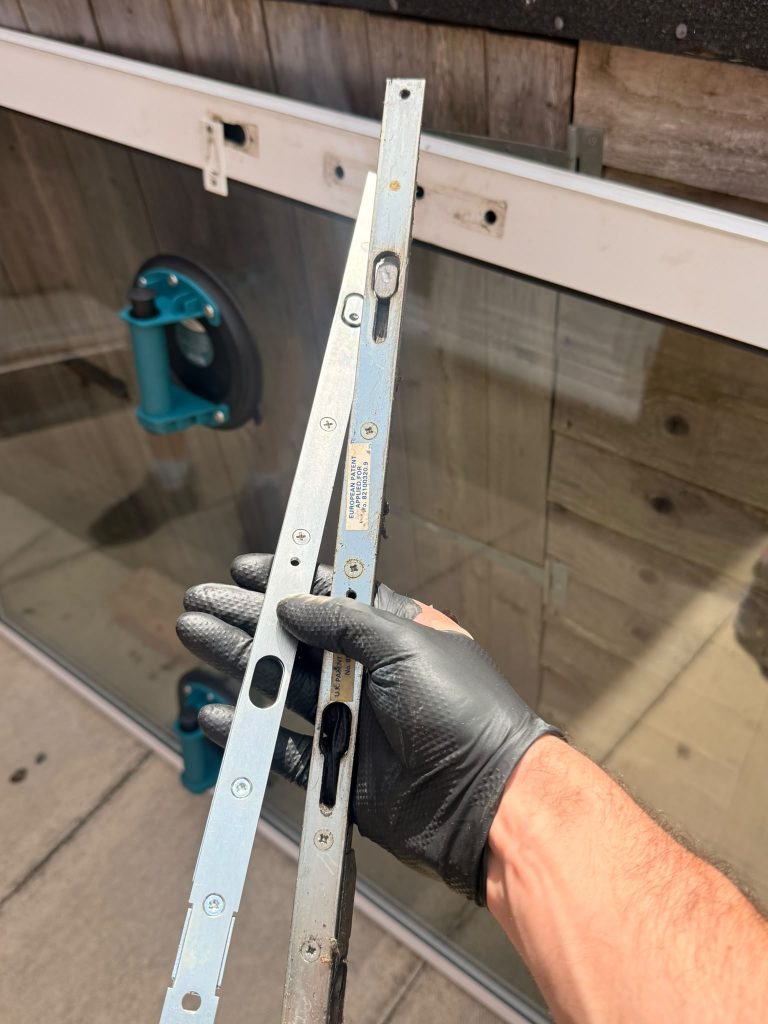
The doors and windows service covers repairs as well as security upgrades, and uPVC door mechanisms fail more often than people expect, particularly on doors used heavily or exposed to direct afternoon sun. The multipoint mechanism that drives the locking bolts can stiffen progressively before it fails, which usually shows up as a door that is increasingly hard to lift and lock, or one that needs the handle heaved firmly upward before the bolts throw.
Composite door alignment is another regular issue. Composite doors are heavier than uPVC equivalents and can drop slightly over time if the hinge fixings were not set into the frame adequately. A dropped composite door will not close cleanly, the multipoint bolts will not meet their keeps, and the door will feel noticeably wrong to use. Hinge adjustment resolves this in most cases without any replacement parts at all.
Window handle failures, broken espagnolette bolts and failed sealed units are covered too. If you can see condensation trapped between the panes of a double-glazed window, the sealed unit has failed and needs replacing, though the frame itself can usually be kept. Our door and window repair service handles all of these.
When to call a locksmith
It is worth acting before a minor fault becomes a security risk or a lockout. Call a locksmith if:
- Your uPVC door is becoming hard to lift and lock
- A composite door has dropped and no longer closes cleanly
- You still have the original, standard cylinder on any external door
- Window handles or locks have failed, or a sealed unit has misted up
- You have had new doors or windows fitted and want the locks brought up to a higher specification
- You have recently experienced a break-in or attempted entry
If you have suffered a break-in, our after-burglary service restores security quickly, and for any lockout our emergency locksmith service covers Nottingham and the surrounding towns.
Straightforward pricing
Max charges £85 plus parts if any are needed, with no call-out fee and no out-of-hours surcharge, and the same price across the whole coverage area, from Nottingham to Derby, Mansfield, Loughborough and the villages between. He is certified, DBS-checked, Checkatrade-approved, fully insured and has more than 600 local reviews behind him. Every job starts with a proper diagnosis, the price is agreed with you before any work begins, and most repairs and upgrades are completed on the same visit. You can see the full list of areas covered on our areas covered page.
Frequently asked questions
What is the most common security weak point on a uPVC door?
The euro cylinder. Standard cylinders fitted to many uPVC doors offer no protection against snapping, which is the most common forced-entry method used in the UK. Replacing a standard cylinder with an anti-snap alternative is the single most effective security upgrade for this type of door, and it is inexpensive relative to the protection it provides.
Do composite doors need anti-snap cylinders too?
Yes. Composite doors are typically fitted with euro cylinders and are subject to the same snapping vulnerability unless an anti-snap cylinder is specifically chosen. Many installers fit whatever cylinder is standard for their supplier, which is not always the highest-specification option, so it is well worth checking and upgrading if needed.
My uPVC door is getting hard to lift and lock. What does that mean?
It usually means the multipoint locking mechanism is wearing out. That mechanism drives the locking bolts when you lift the handle, and as it stiffens the handle becomes harder to operate. Left alone it will eventually fail completely. Replacing the mechanism is a straightforward repair that does not require changing the door furniture.
Can a composite door that has dropped be repaired?
In most cases, yes. A dropped composite door is usually caused by hinge fixings that have worked loose or were not set deeply enough into the frame when the door was installed. Adjusting or re-fixing the hinges resolves it in the majority of cases, often without any replacement parts.
What should I look for when buying a new door for security?
Beyond appearance and price, ask specifically about the cylinder specification and whether the frame comes with reinforced keeps. A door sold as secure but fitted with a standard cylinder and weak keeps is not as secure as it looks. The door, cylinder, mechanism and frame all need to be up to standard together.
Sorted? What most readers check next
- Window repairs — handles, hinges & mechanisms
- Locksmith prices in Nottingham — the transparent 2026 guide
- Door Repair Service for Stuck or Damaged Doors
- Best Locks for Front Doors Explained
Need it sorted today? Call 07552 421433 — £85 + parts (+ VAT), no call-out fee, same price 7 days.