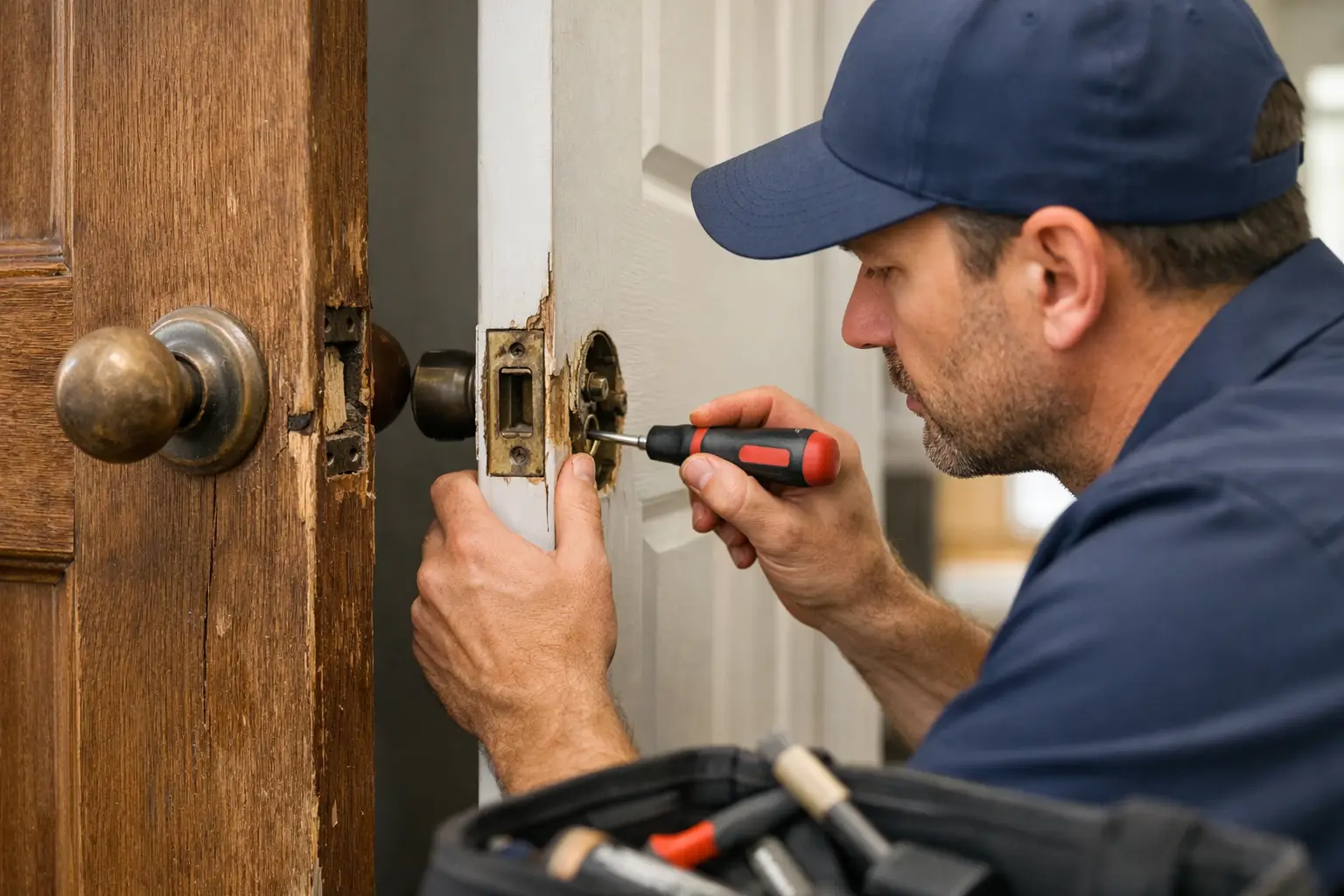
This is the most common composite door complaint, and it almost always points to the multi-point gearbox rather than the lock itself. The gearbox is the central mechanism housed within the edge of the door that converts the upward movement of the handle into the extension of the locking bolts at the top and bottom of the door. When it wears, the handle becomes progressively stiffer, requires more force to lift, and eventually refuses to move the bolts at all.
Many homeowners assume this is a door alignment problem and adjust the hinges before calling a locksmith, which often makes no difference because the alignment was not the cause. A gearbox that is wearing will feel gritty or notchy under load rather than smooth, and the resistance will be consistent across the full lift of the handle. Gearbox replacement is a straightforward repair that does not require the door furniture to be replaced.
Composite doors are heavier than uPVC equivalents, and the hinges carry that weight continuously for years. A door that drops slightly will not close cleanly against the frame, the multi-point bolts will not align with their keeps, and the door will require lifting slightly to close. Left alone, this puts additional stress on the gearbox and accelerates wear.
The cause is almost always hinge related. Either the fixing screws have worked loose in the frame, the hinge has bent slightly under the sustained load, or the original installation did not set the hinges deeply enough into the frame. Hinge adjustment resolves the drop in most cases and can usually be made without removing the door.
The signs to look for are a visible gap at the top of the door on the handle side, a locking bolt that does not sit cleanly in its keep, and a door that requires lifting from the handle to close. Any of these, and particularly all three together, point to hinge drop.
A draught through a composite door is almost always a seal issue rather than a door construction problem. Composite doors use compression seals around the full perimeter of the frame, and these seals are designed to compress against the door face when it is closed. When the seal deteriorates or the door has dropped slightly, the compression is lost and cold air finds its way through.
The first step is to check the door alignment before replacing any seals. A door that has dropped may appear to have failing seals when the real problem is that it is no longer sitting in the right position. If the alignment is correct and the draught persists, the perimeter seal should be inspected for cracking, hardening, or visible compression damage. Draughts from the letterbox are a separate issue; letterbox seals have a limited lifespan and are a common source of cold air infiltration.
Composite doors are typically fitted with euro cylinders, and the cylinder experiences the same wear as any other. Lubricating the cylinder with a graphite or PTFE-based product, rather than an oil-based one which can attract debris, will sometimes resolve stiffness in the early stages. If the stiffness persists or the key is beginning to feel notchy under rotation, the cylinder needs replacing.
It is also worth checking whether the cylinder is the correct length for the door profile. Cylinders that protrude past the backplate create a lever point that makes snapping easier. A cylinder that is correctly sized sits flush with the backplate and provides no grip point for an attack.
The Handle Is Loose or Not Returning to Position
Handle looseness on a composite door usually has one of two causes. Either the fixing screws on the handle plate have worked loose, which is a simple tightening job, or the spring return mechanism inside the handle furniture has failed. The spring is what causes the handle to return to the horizontal position after you have lifted and released it. When the spring fails, the handle stays where you leave it. Spring return failure is particularly common on handles used many times a day, and handle furniture replacement is a low-cost repair that restores full function immediately.
Composite doors with decorative glazed panels can develop condensation between the panes, which indicates that the hermetic seal on the double-glazed unit has failed. This is a glazing unit problem rather than a door problem, and the solution is to replace the sealed unit rather than the whole door panel. The glass unit can usually be removed from the door frame, the replacement unit fitted, and the door reglazed without removal from its hinges.
For most of the problems above, a locksmith visit is the appropriate first step. The gearbox, cylinder, hinges, and seals are all within the scope of what Max attends to regularly, and the diagnostic process is quick once the door has been assessed in person. Most composite door repairs can be completed on a single visit with parts carried in the van.
Max attends composite door repairs across Nottingham and the surrounding areas with no call-out fee. If a problem sounds familiar from the descriptions above, a phone call is usually enough to establish what the likely cause is and what the visit will involve.